
Continuous electrodeionization after RO: an electric field and ion-exchange membranes strip the remaining ions, with no acid or caustic regeneration. Near-zero TDS, lab-grade water — typically 10–15+ MΩ·cm, up to 18.2 MΩ·cm with a mixed-bed polish — for laboratories, pharma, power and boiler makeup.
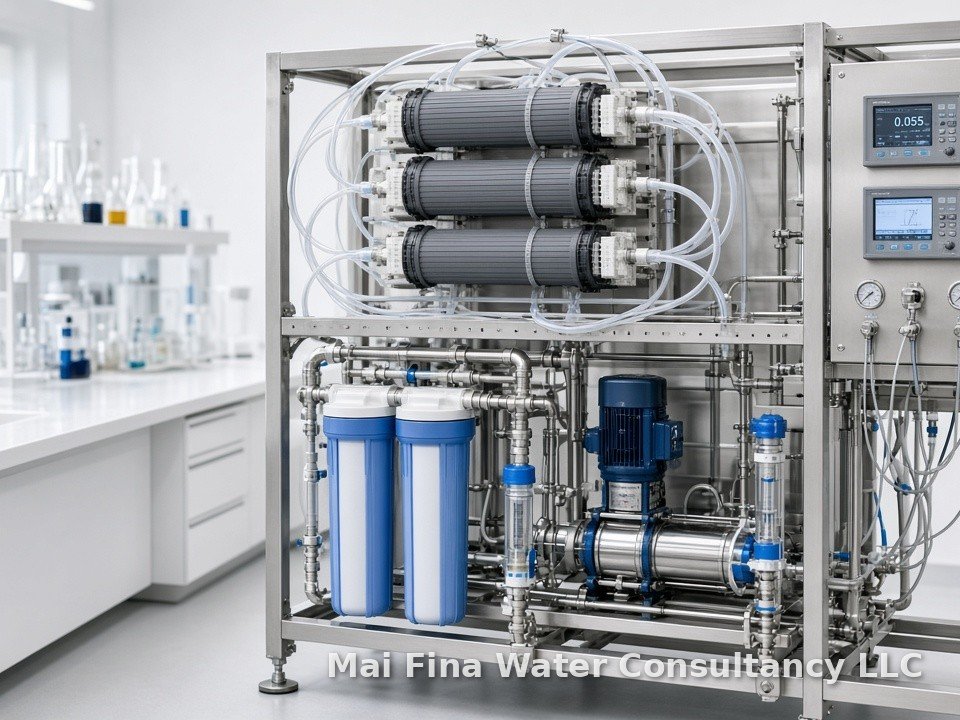
Electrodeionization (EDI) is an electrically driven polishing stage installed after reverse osmosis. A DC field pulls ions out of the RO permeate through ion-exchange resin and membranes into a small concentrate stream. The resin is regenerated continuously by the current itself, so there is no acid, no caustic and no regeneration downtime.
RO + EDI typically delivers 10–15+ MΩ·cm (≈0.1–0.07 µS/cm). Where a lab or process specifies 18.2 MΩ·cm, a final mixed-bed or point-of-use polish is added. Online resistivity / conductivity monitoring diverts off-spec water to drain or recirculation.
Laboratories (analytical, clinical, research), pharmaceutical purified water, power and boiler makeup, electronics and process rinse — anywhere near-zero TDS water is needed without the chemical handling of regenerable DI.
From compact laboratory skids (400–2,000 GPD: pretreatment, RO, EDI module, polish, resistivity meter) to industrial trains of 10,000–100,000 GPD (2-pass RO + EDI + mixed-bed polish, divert valve, PLC panel). DI cartridges and regenerable DE-M remain available where they suit the duty better.
Feed water analysis (TDS, hardness, silica, CO₂, chlorine), required product quality (MΩ·cm or µS/cm), daily volume and peak draw, point-of-use list and available space and power.
Included: pretreatment and RO as BOQ, EDI stack, power supply, polish, instrumentation, panel, commissioning and quality log. Excluded unless written: civil works, distribution piping beyond the skid, lab-specific validation documentation.
| Parameter | Typical |
|---|---|
| Capacity / flow | Typical 0.1 to 20 m³/h |
| Product water | Typical 5 to 16 MΩ·cm resistivity |
| Feed requirement | RO permeate, typical conductivity below 20 µS/cm |
| Operating pressure | Typical 2 to 6 bar |
| Recovery | Typical 90 to 95% |
| Materials | SS316 / uPVC piping, EDI modules on frame |
| Power | 380-415V / 3ph / 50Hz or 220-240V / 1ph / 50Hz with DC power supply |
| Footprint | Typical 1 x 0.8 m to 4 x 1.5 m |
| Controls / instrumentation | PLC, resistivity / conductivity meters, flow and pressure sensors, DC current control |
Typical values. Final specifications depend on feed water analysis and site requirements.
Send your water analysis and duty to info@maifina.com or WhatsApp / call +971 55 521 7294.