
RO chemicals for brackish water and seawater RO
RO chemicals from Mai Fina: antiscalants, low-pH and high-pH CIP cleaners, non-oxidizing biocide, SMBS dechlorination, pH adjustment and coagulants for brackish water RO (BWRO) and seawater RO (SWRO) plants across the UAE, matched to your water analysis and membranes.
What RO chemicals do
As RO concentrates the feed, sparingly soluble salts such as calcium carbonate, calcium sulphate, barium and strontium sulphate and silica can scale the tail-end membranes, while chlorine, organics and bacteria damage or foul them. The right chemical program keeps permeate flow and salt rejection stable, cuts cleaning frequency and extends membrane life.
Key features and benefits
- Antiscalants selected from your feed water analysis and the plant’s recovery, not a one-size product.
- Membrane-compatible chemicals for polyamide thin-film RO membranes.
- NSF/ANSI 60 certified grades supplied where available for drinking water plants.
- Phosphorus-free green options (PESA, PASP, HPMA) where concentrate discharge rules restrict phosphorus.
- CIP cleaning programs with low-pH and high-pH cleaners, run by our team or trained to your operators.
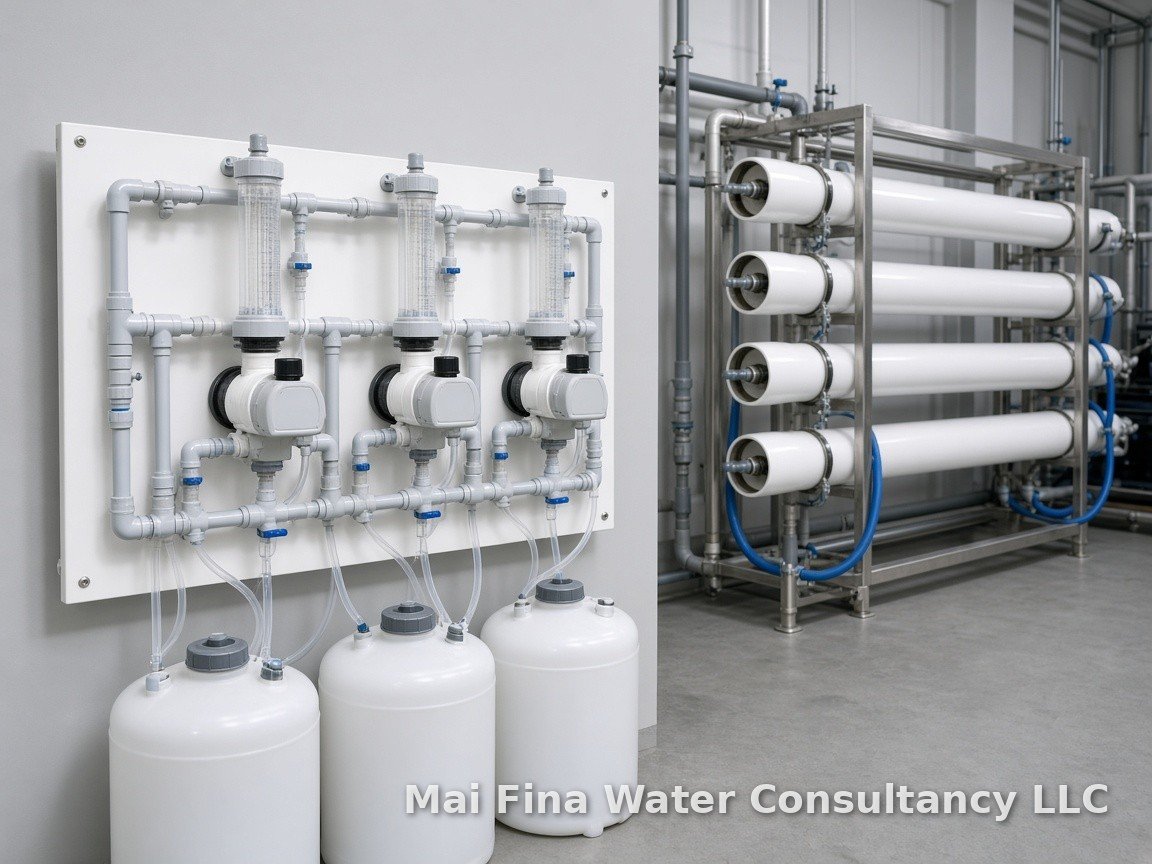
- Dosing pumps, day tanks and dosing skids supplied, installed and calibrated.
Antiscalant chemical names and codes
Standard chemical names, industry acronyms and CAS registry numbers of the active ingredients used in RO antiscalants. Most RO antiscalants are blends of a phosphonate and a polymer.
| Code / acronym | Chemical name | CAS No. | Type | Main scale controlled |
|---|---|---|---|---|
| ATMP | Amino tris(methylene phosphonic acid) | 6419-19-8 | Phosphonate | CaCO3 and CaSO4 threshold inhibition |
| HEDP | 1-Hydroxyethylidene-1,1-diphosphonic acid | 2809-21-4 | Phosphonate | CaCO3 scale, iron stabilisation |
| PBTC (PBTCA) | 2-Phosphonobutane-1,2,4-tricarboxylic acid | 37971-36-1 | Phosphonocarboxylic acid | CaCO3 at high hardness and high pH, chlorine tolerant |
| DTPMP | Diethylenetriamine penta(methylene phosphonic acid) | 15827-60-8 | Phosphonate | BaSO4, SrSO4 and CaSO4 sulphate scales |
| PAA | Polyacrylic acid | 9003-01-4 | Polymer (polycarboxylate) | Dispersion of CaCO3, silt and silica |
| PAAS | Sodium polyacrylate | 9003-04-7 | Polymer (polycarboxylate) | Neutralised form of PAA for dispersion |
| HPMA | Hydrolysed polymaleic anhydride (polymaleic acid) | 26099-09-2 | Polymer, phosphorus-free | CaCO3 at high temperature and high LSI |
| MA/AA | Maleic acid / acrylic acid copolymer | 26677-99-6 | Copolymer | CaCO3 and CaSO4 dispersion |
| AA/AMPS | Acrylic acid / 2-acrylamido-2-methylpropane sulfonic acid copolymer | 40623-75-4 | Sulfonated copolymer | Calcium phosphate, iron and silica dispersion, high calcium tolerance |
| PESA | Polyepoxysuccinic acid (sodium salt) | 51274-37-4 (sodium salt also listed as 109578-44-1) | Green, phosphorus-free, biodegradable | CaCO3 and CaSO4 where phosphorus discharge is restricted |
| PASP | Polyaspartic acid, sodium salt | 181828-06-8 (also listed as 35608-40-6) | Green, phosphorus-free, biodegradable | CaCO3 and CaSO4, low-phosphorus concentrate discharge |
Brackish water RO (BWRO) antiscalants
Brackish wells and surface water in the UAE often carry high hardness, sulphate and silica, and BWRO plants run at high recovery, so calcium carbonate, calcium sulphate and silica limit the design.
- ATMP (6419-19-8), HEDP (2809-21-4) and PBTC (37971-36-1) phosphonate blends for CaCO3 and CaSO4.
- DTPMP (15827-60-8) where barium or strontium sulphate is present.
- AA/AMPS copolymer (40623-75-4), PAA (9003-01-4) and MA/AA (26677-99-6) as dispersants for silica, iron and silt at high recovery.
- PESA (51274-37-4) and PASP (181828-06-8) phosphorus-free options where reject goes to sensitive discharge.
Seawater RO (SWRO) antiscalants
Gulf seawater is high in TDS and has a high LSI, but SWRO runs at lower recovery, so the main risk is calcium carbonate at the concentrate end, with some calcium sulphate.
- Polymer / phosphonate blends of HPMA (26099-09-2) or PAA (9003-01-4) with PBTC (37971-36-1) or ATMP (6419-19-8), effective at high LSI and low dose.
- HPMA (26099-09-2) phosphorus-free polymer for CaCO3 at high LSI and temperature.
- PESA (51274-37-4) and PASP (181828-06-8) green antiscalants where low-phosphorus brine discharge to sea is required.
- NSF/ANSI 60 certified grades for potable SWRO plants where available.
Antiscalant type and dose are set by membrane-manufacturer or antiscalant projection software from your full water analysis, recovery and temperature. We do not quote a fixed dose before that projection.
Cleaners, biocide and other RO chemicals
| Chemical | Name / type | CAS No. | Purpose |
|---|---|---|---|
| DBNPA | 2,2-Dibromo-3-nitrilopropionamide | 10222-01-2 | Non-oxidizing biocide, membrane compatible |
| SMBS | Sodium metabisulfite | 7681-57-4 | Dechlorination ahead of the membranes |
| Low-pH CIP cleaner | Acid cleaner (e.g. citric acid based) | – (blend) | Removes carbonate scale and metal oxides |
| High-pH CIP cleaner | Alkaline cleaner with surfactant / chelant | – (blend) | Removes organic, biofilm and silt fouling |
| pH adjustment | Acid or caustic for feed pH control | – | Lowers LSI or raises boron/CO2 rejection where designed |
| Coagulants / flocculants | e.g. ferric chloride, polyaluminium chloride | – | Pretreatment ahead of media or UF filtration |
Oxidizing biocides such as chlorine must be removed before polyamide membranes; SMBS is dosed for dechlorination and DBNPA is used as a membrane-compatible non-oxidizing biocide.
Applications
Brackish well RO for farms, camps, factories and hotels; seawater desalination plants and containerized SWRO; food and beverage, bottled water and boiler make-up RO; RO ahead of EDI and DI polishing.
Design data we need
Full feed water analysis (including Ca, Mg, Ba, Sr, SO4, HCO3, SiO2, Fe, pH, temperature), RO recovery and flow, membrane type, and current dosing and cleaning history.
Specifications
| Parameter | Typical |
|---|---|
| Product types | Antiscalants, biocides, dechlorination, CIP cleaners, pH adjusters, coagulants |
| Identification | CAS numbers as listed above, per product |
| Purity / grade | Technical or NSF/ANSI 60 grade where available |
| Dosing | Typical antiscalant dose 2 to 5 mg/L, set from projection software |
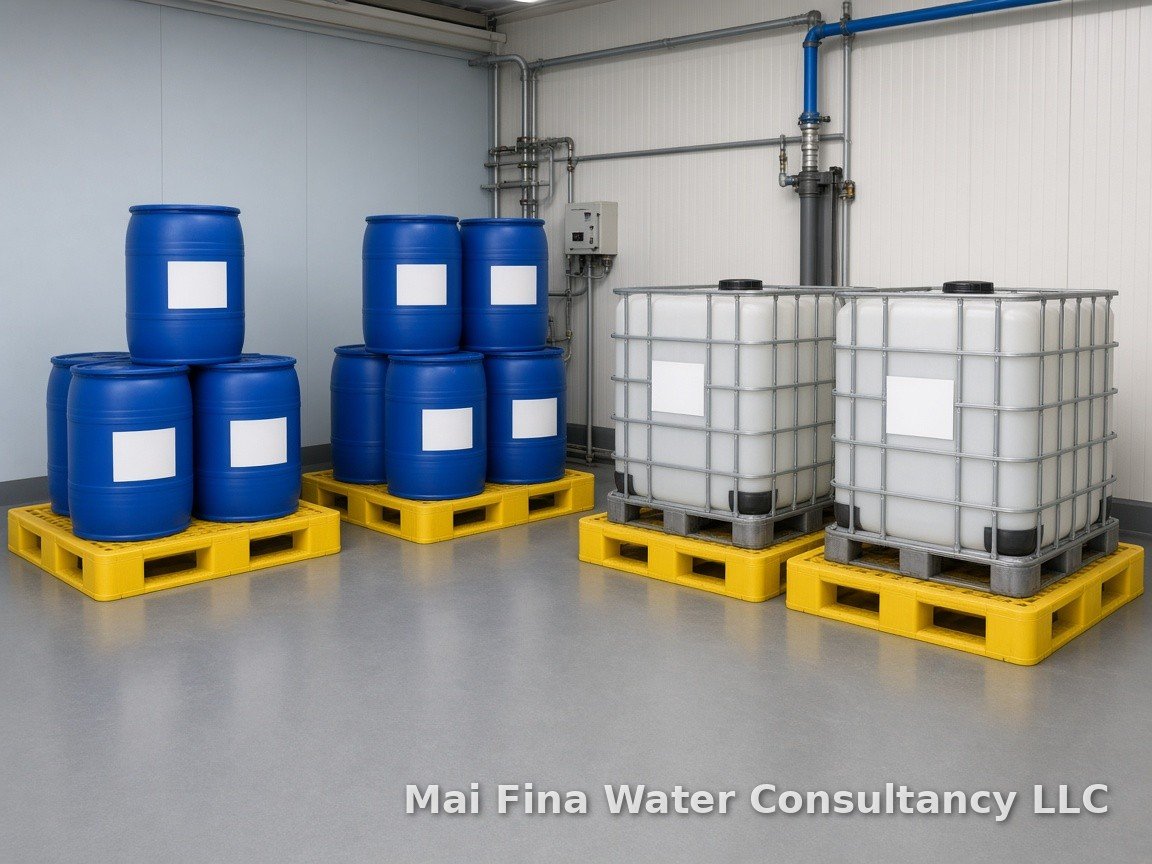
| Packaging | Typical 25 kg drums, 200 L drums, 1,000 L IBC |
| Storage | Shaded, ventilated storage per SDS |
| Documentation | SDS and certificate of analysis |
Typical values. Final specifications depend on feed water analysis and site requirements.
Talk to us
Send your water analysis and duty to info@maifina.com or WhatsApp / call +971 55 521 7294.